
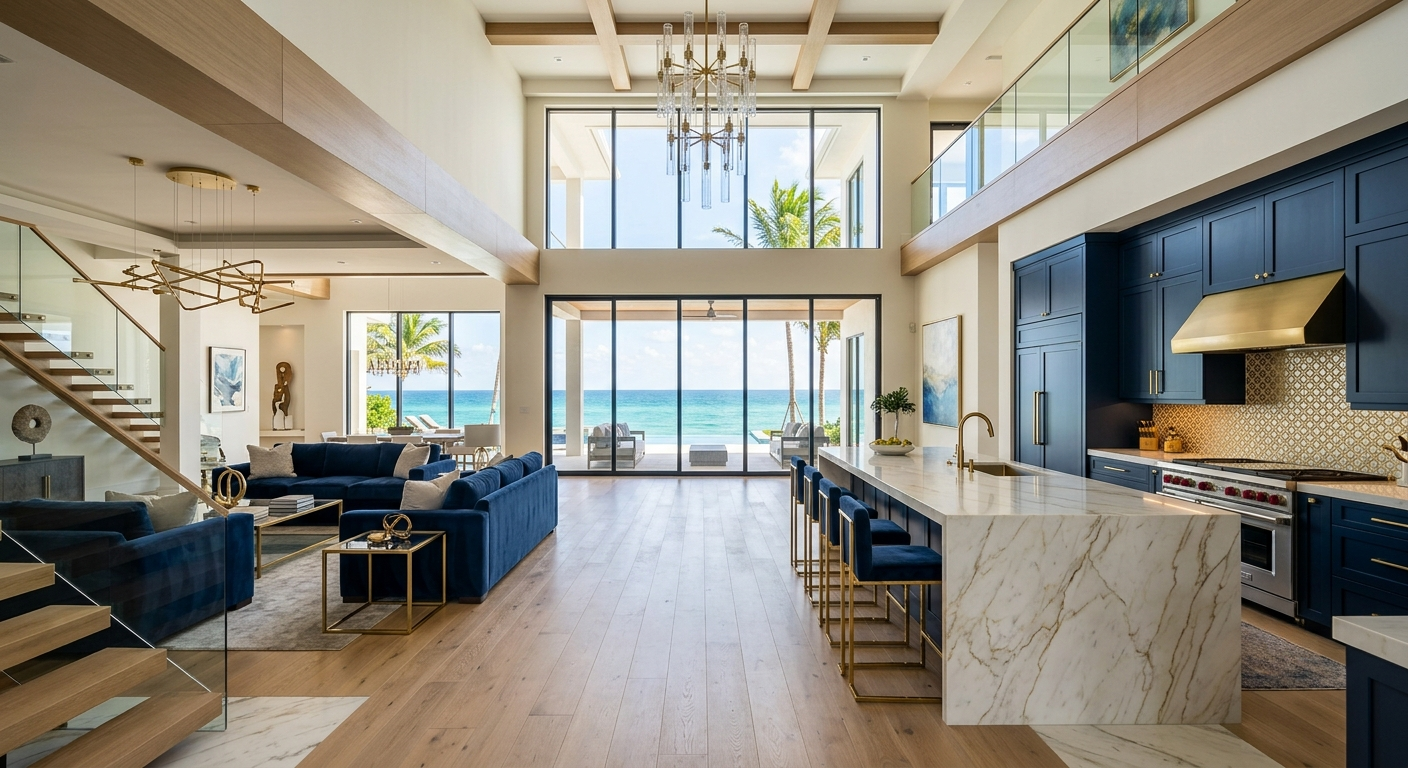
Florida’s Ultra-Luxury New Construction Boom: Where the Smart Money Is Moving — and What’s Coming Next
The insider’s guide to the hottest markets, the next wave of prime locations, and everything you need to know about ground-up construction financing before you break ground.
I spent the morning on the phone with a ground-up construction lender and a Central Florida developer who builds in the $3M–$12M range. The question they both kept circling: where is the smart money going in Florida’s luxury new construction market right now? Not where it went in 2021. Right now.
The answer is more nuanced than any single headline will tell you. Florida’s overall housing market has cooled and stabilized — but at the very top, the ultra-luxury new construction market is running on its own engine entirely. And understanding which markets are peaking, which are just getting started, and how the financing actually works? That’s where the real opportunity lives.
Whether you’re a high-net-worth buyer searching for your next primary or second home, a developer scoping your next build, or an investor looking to get in before the curve steepens — this guide is for you.
Where the Ultra-Luxury New Construction Boom Is Happening Right Now
Let me be direct: Florida’s ultra-luxury new construction market is not a monolith. It’s a collection of micro-markets, each with its own buyer profile, price dynamics, and development pace. Here’s where the action is right now.
Palm Beach County Corridor
🔥 PeakThe stretch from West Palm Beach through Boca Raton to Palm Beach Gardens is the epicenter of South Florida’s branded-residence explosion. Flagship projects — Mandarin Oriental Boca Raton, Ritz-Carlton Residences Palm Beach Gardens, the proposed Aman Palm Beach — are redefining what “luxury” means in this corridor.
Highland Beach, Ocean Ridge, and Manalapan command rarefied attention: new construction here is scarce by zoning design, which makes available inventory intensely competitive. A $39.9M new construction oceanfront estate on S Ocean Blvd in Highland Beach was on the market as we published this.
Miami / Brickell / Sunny Isles
🔥 PeakMiami is no longer just a lifestyle play — it’s a global capital for ultra-luxury real estate. Brickell leads with $950/sq ft luxury condo pricing; Miami Beach commands $1,292/sq ft. The pipeline heading into 2026 is defined by branded, low-density towers — 888 Brickell by Dolce & Gabbana, Missoni, Fendi, Armani/Casa — where the architecture and the lifestyle programming are as important as the square footage.
New inventory at the very top is intentionally scarce and heavily pre-sold. This is not a market where you browse casually — deals happen quietly.
Naples / Gulf Coast
↑ RisingNaples is the anti-Miami for luxury buyers who want pristine beaches and world-class golf without the density. The Gulf Coast from Sarasota to Naples is growing a serious ultra-privacy luxury brand — deep-water yacht access, fortified smart homes, and exclusive community living.
Naples, Palm Beach Island, and Boca Raton all remain stable even as the broader market cools — a direct function of cash-buyer prevalence and limited inventory. Ultra-prime here behaves differently from the rest of the state.
“At the very top of the Florida luxury market, price is no longer the primary differentiator. Buyers are evaluating architecture, privacy, service culture, and lifestyle programming with the same rigor they once reserved for a private yacht.”
Searching for Ultra-Luxury New Construction?
I work with buyers across Central and South Florida — including Palm Beach County, Naples, and the Gulf Coast corridor. Let’s talk about what’s actually available and what’s coming to market.
The Next Wave: Where Luxury New Construction Is Heading Before Everyone Else Arrives
The signals are familiar if you know what to look for: luxury retailers scouting locations, zoning variances being approved, branded hotel flags announcing residences, and private club memberships quietly selling out before the first shovel hits the ground. Here’s where I’m watching.
Sarasota / Venice
↑ AcceleratingSarasota is quietly becoming the destination for luxury buyers who want the Gulf Coast lifestyle without the Naples price premium — for now. Top-ranked schools, arts infrastructure, and deep boating access make this a genuine primary-residence market, not just a vacation play. Investor saturation is still low here compared to South Florida, which protects long-term asset quality.
Watch: Bonita Springs and Estero, where inventory stabilization is creating entry windows before the next appreciation cycle.
Orlando’s Horizon West / Windermere
↑ Watch CloselyAnalysts are projecting 2–3% value growth in Orlando’s Horizon West enclave — modest but meaningful in a market where luxury is still finding its floor. Windermere remains Central Florida’s most prestigious address, and the luxury new construction activity along the Butler Chain corridor is drawing serious attention from North American relocators. The difference between Windermere and South Florida? You can still find a buildable lot.
This is my neighborhood. I know these streets, these builders, and these comps intimately.
Riviera Beach / Jupiter / Palm Beach North
👀 Early SignalIndustry experts have explicitly flagged Riviera Beach as an emerging luxury market. Jupiter and northern Palm Beach County are seeing new-construction single-family and boutique condominium activity that mirrors the early-stage signals we saw in West Palm Beach five years ago. The Ritz-Carlton flag in Palm Beach Gardens is a major leading indicator — branded flags don’t go where the market isn’t going.
Tampa Bay Waterfront Pockets
👀 SelectiveThe Tampa Bay suburbs overall are seeing post-boom valuation adjustments. But the waterfront luxury pockets — Davis Islands, Harbour Island, Avila — are behaving differently. Affluent relocators from the Northeast and California are still choosing Tampa as a primary destination, and they’re not building modest homes. Selective new construction in these micro-markets continues to command premium pricing.
What Early-Stage Market Signals Actually Look Like
Before a market goes on everyone’s radar, certain precursors appear. Based on patterns visible in markets like West Palm Beach and Brickell before they exploded, watch for:
- Branded hotel flags announcing residences — Ritz, Four Seasons, Aman, Mandarin Oriental all land in markets they believe will appreciate significantly
- High-end retail signings — Hermès, Louis Vuitton, Porsche Design stores follow wealthy populations, not lead them
- Zoning variances for height and density — Boca Raton just approved a height increase for the resort tower from 85 to 100 feet. These votes are meaningful
- Private club memberships moving fast — golf, yacht, and social clubs in the path of luxury development tend to see membership waitlists form 18–36 months ahead of peak development
- Family office real estate arms going quiet — when wealthy families stop listing and start accumulating in a market, that’s the most reliable signal of all
Ground-Up New Construction: What Actually Happens from Lot to Certificate of Occupancy
If you’re a developer — or thinking about becoming one — knowing the process in sequence matters as much as knowing the market. Here’s how a ground-up luxury new construction project actually unfolds in Florida.
Site Acquisition & Feasibility Analysis
Identify the parcel, confirm zoning and entitlements, assess flood zone designation, utilities access, and any deed restrictions. Run a preliminary pro forma — what’s the land cost, estimated build cost, and projected ARV? This analysis determines whether the deal pencils before you spend a dollar on plans.
Design, Plans & Permitting
Engage a licensed architect to produce construction drawings. Plans go to the local building department for permit review — in Palm Beach County, this can take 4–12 weeks depending on complexity and submission quality. Luxury custom homes require full structural, MEP (mechanical/electrical/plumbing), and civil engineering sets.
Construction Financing & Loan Closing
This is where you finalize your capital stack: the ground-up construction loan covers a defined percentage of your total project cost (more on this in the next section). The loan closes, a draw schedule is established, and construction can begin. Expect 2–3 weeks for closing with a well-prepared file at the right lender.
Foundation Through Framing
Ground breaking, slab pour, stem walls or pilings (required in coastal and flood-zone areas), and structural framing. In Florida, this phase demands particular attention to wind and storm engineering codes — especially post-Ian in Southwest Florida, where code updates have added requirements and costs. Budget for geotechnical surprises.
Rough-In: Plumbing, Electrical, HVAC
All systems go in before walls close. For luxury builds, this phase also includes smart home infrastructure (structured wiring, AV pre-wire, security systems), solar or whole-home generator rough-in, and high-efficiency HVAC systems increasingly required for insurance purposes. Material lead times for custom fixtures can significantly affect timeline — order early.
Finishes, Fixtures & Punch List
This is where your vision becomes a home — custom cabinetry, stone countertops, flooring, trim work, pool and spa, exterior landscaping and lighting. For ultra-luxury builds, this phase takes as long as — or longer than — structural construction. European cabinetry has 12–16 week lead times. Sub-zero appliance packages have their own timelines. Plan accordingly.
Certificate of Occupancy & Exit
The CO is issued, the project is complete, and you execute your exit strategy: sale of the completed spec home, or refinance into a permanent loan (conventional, DSCR, or portfolio product depending on the buyer’s or investor’s situation).
Ground-Up Construction Loans: What Lenders Actually Look For (And What Most Guides Won’t Tell You)
I have conversations with lenders every week. And the single biggest gap I see between developers who get funded and those who don’t isn’t the deal itself — it’s how prepared and how packaged the file is. Here’s what lenders actually care about, straight from the source.
The Capital Stack: LTC vs. LTV — Know the Difference
| Metric | What It Means | Typical Range (2026) | Why It Matters |
|---|---|---|---|
| Loan-to-Cost (LTC) | Loan amount ÷ total project cost (land + hard + soft costs) | 75–85% LTC | Defines how much equity you must bring to the project — typically 15–25% |
| Loan-to-Value (LTV) | Loan amount ÷ appraised ARV of the completed project | 65–75% LTV | Both LTC and LTV limits must be met — the lower ceiling controls |
| Interest Rate | Rate on drawn funds only | 7.5%–9% (residential luxury); 6.5%–9% (commercial) | Interest-only payments; rate is higher than conventional to offset lender risk on an asset that doesn’t yet exist |
| Loan Term | Construction period duration | 12–24 months (simple); up to 36 months (complex) | Extension options are available but cost money — build in a realistic buffer |
| Minimum Down / Equity | Borrower equity contribution | 20–35% | Some private lenders reduce this for experienced developers with strong exit plans |
What Lenders Require — The File Checklist
For a $2M–$10M luxury construction loan, expect lenders to evaluate these elements:
- Land ownership or executed purchase contract — owned free and clear is ideal; under contract is fine with proof of earnest money
- Detailed construction budget — line-item by trade, with contingency (typically 10–15% for luxury builds)
- Architectural plans and permit status — permit-ready projects close faster; preliminary plans acceptable with the right lender
- Developer/builder experience — past luxury builds, references, licenses, and insurance certificates for the general contractor
- Exit strategy with comparable sales support — detailed ARV analysis; comps must be truly comparable in finish level and location
- Personal financials — bank statements, tax returns (for conventional construction lenders); private lenders may prioritize asset-based analysis
- Completed project value projection — supported by an independent appraisal ordered by the lender
“Private lenders focus on project value, developer experience, and exit strategy — not just your income. For spec and custom luxury builds where traditional bank financing falls short, this is the path forward.”
The Draw Schedule: How Funds Are Released
Construction loans don’t deliver a lump sum — they disburse in stages as verified work is completed. A typical luxury build draw schedule flows like this:
| Draw | Milestone | Approx. % of Loan |
|---|---|---|
| Initial Draw | Land acquisition or reimbursement if already owned; site preparation | 15–20% |
| Draw 2 | Foundation complete and inspected | 15% |
| Draw 3 | Framing complete; roof dried in | 20% |
| Draw 4 | Rough-in complete (plumbing, electrical, HVAC) and inspected | 15% |
| Draw 5 | Drywall, insulation, exterior complete | 15% |
| Final Draw | Certificate of Occupancy issued; all punch list items complete | 15% |
Draw percentages vary by lender and project. Each draw is typically preceded by a third-party lender inspection confirming the milestone is complete.
What About First-Time Builders?
This comes up often — especially in the luxury spec home space, where I work with both seasoned developers and first-time builders who have the capital and vision but not yet a track record. Here’s what you need to know:
- Some private lenders will work with first-time builders, but they tighten the LTV cap — often to 60–65% of ARV rather than 70–75%
- A stronger builder/GC on the project (licensed, insured, with documented luxury build experience) offsets borrower inexperience significantly
- Larger equity contributions — sometimes 30–40% — can unlock programs that experience would otherwise provide
- A clearly documented, conservative exit plan with strong comp support is non-negotiable
Need Construction Financing for a Florida Luxury Build?
I work directly with ground-up construction lenders in the $500K–$10M+ range — including programs for first-time builders and foreign national investors. Let’s structure your deal right from the start.
Frequently Asked Questions: Florida Ultra-Luxury New Construction
Ready to Make Your Move in Florida’s Luxury New Construction Market?
Whether you’re searching for your next home, planning a ground-up build, or need financing structured before you go to contract — I’m the one call that covers both sides of the transaction. 24 years in Central and South Florida. One agent, one lender, no runaround.
This content is for informational purposes only and does not constitute legal, financial, or investment advice. Real estate market conditions change rapidly; all statistics referenced were accurate as of publication date, June 2026. Florida SB 264 restricts certain foreign nationals from purchasing specific types of real estate in Florida — consult a qualified Florida attorney before transacting. Construction loan terms, rates, and requirements vary by lender and borrower profile. Equal Housing Opportunity. Stacy Ann Stephens is a licensed Florida REALTOR® with Keller Williams Realty Winter Park and a licensed Mortgage Broker NMLS #1933745, Jhenesis Mortgage NMLS #2532705.
Ready to start your luxury search? One call handles both sides.
Book a Consultation Call (407) 603-1664